Indoor air quality is something most people in Singapore think about in the context of air purifiers, plants, or ventilation — but very few consider the significant role their rugs play. Your rug, sitting quietly on the floor, is one of the largest and most active filters in your home. It traps dust, allergens, pollutants, and biological matter that would otherwise remain airborne. But when it fills up, and is not regularly deep cleaned, it stops filtering and starts releasing. Understanding this dynamic helps explain why deep rug cleaning is not just an aesthetic choice — it is a health one.
What Your Rug Is Actually Trapping
- Dust mites and their waste — Singapore’s warm, humid climate is ideal for dust mite proliferation. A rug that has not been deep cleaned in some time can harbour thousands of mites per gram of dust. Their waste particles are a major trigger for asthma and allergic rhinitis.
- Pet dander — Microscopic skin flakes from pets become embedded in rug fibres and remain potent allergens for months or years.
- Mould spores — High ambient humidity, occasional moisture from spills, and trapped organic matter create conditions where mould can develop within the rug’s backing and pile.
- Fine particulate matter — PM2.5 and smaller particles from outdoor air, cooking, and combustion sources settle into rug fibres and accumulate over time.
- Bacteria and viruses — Studies have consistently shown that carpets and rugs carry significantly higher bacterial loads than equivalent hard floor areas. Regular deep cleaning substantially reduces this biological burden.
When Rugs Become an Air Quality Liability
A rug acts as a beneficial filter when its capacity to hold particles exceeds the rate at which it releases them. Once it becomes saturated — particularly when foot traffic disturbs the pile and releases accumulated particles back into the air — the dynamic reverses. At that point, walking across your rug temporarily raises the particulate concentration in the room around it.
This is the central reason why regular vacuuming alone is not sufficient to maintain indoor air quality. Vacuuming addresses the surface and upper layers of the pile. The fine particles, allergens, mould spores, and biological matter that have settled deep into the base of the pile are not reached by standard vacuuming. Only deep cleaning methods — particularly hot water extraction — can effectively extract this embedded contamination.
The Singapore Context: Why Deep Cleaning Matters More Here
Singapore’s climate accelerates the accumulation of contaminants in rugs in ways that are not experienced in cooler, drier climates. Average indoor relative humidity in a Singapore home is typically between 60% and 80% — higher than the range considered optimal for indoor air quality. Dust mites thrive above 50% relative humidity. Mould growth is substantially more likely at higher humidity levels. The result is that Singapore rugs accumulate biological contamination faster than those in temperate countries.
Air conditioning provides some relief but also contributes to the problem in a different way — by circulating fine particles continuously through the room, it helps deliver particulate matter to the rug surface faster than natural settling would. The rug fills faster, and therefore reaches the point of releasing more than it captures sooner.
Who Is Most Affected by Rug-Related Air Quality Issues
- Children who play on the floor are in the closest proximity to rug-released particles and have developing immune systems that are more reactive to allergens
- Elderly family members, particularly those with respiratory conditions like COPD or asthma
- Anyone with diagnosed dust mite allergy, pet allergy, or mould sensitivity
- Infants and toddlers, who have higher breathing rates relative to body size and spend more time at floor level
What Deep Cleaning Actually Does for Air Quality
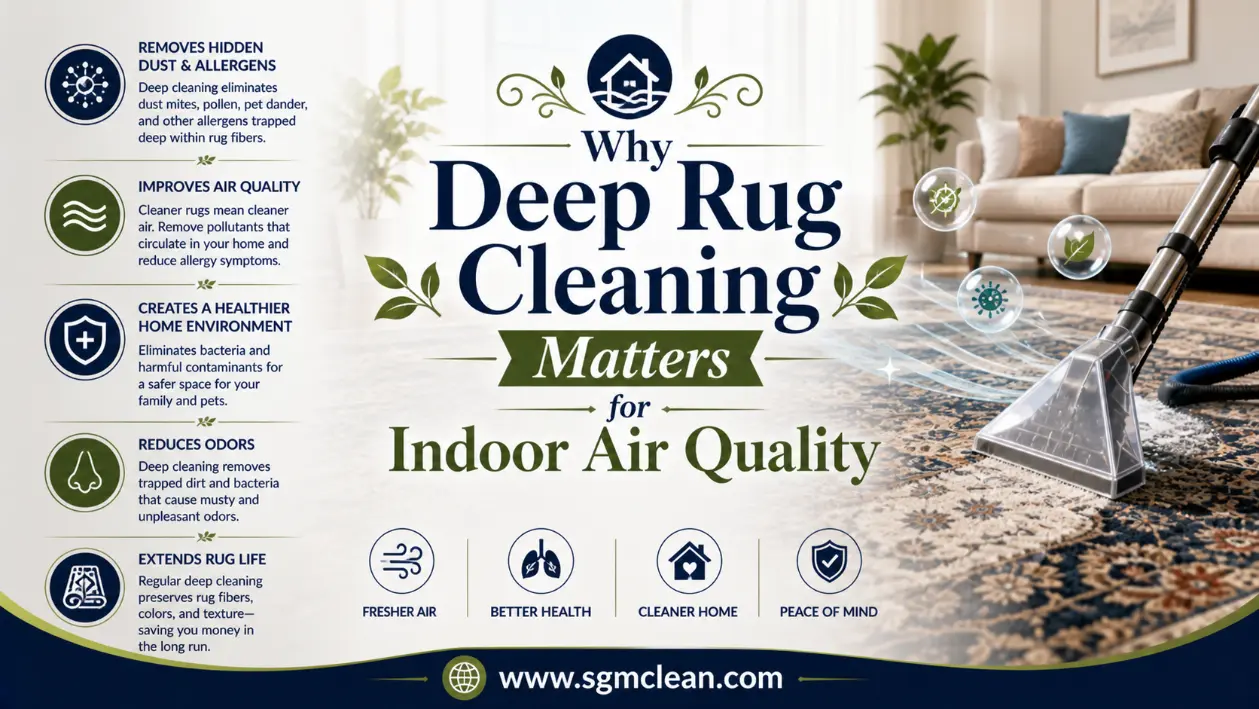
A professional deep clean using hot water extraction removes the accumulated load of allergens, mould, bacteria, and particulate matter from the rug’s full depth — not just the surface. The immediate effect is a substantial reduction in the biological material available to become airborne through normal use. Dust mite populations are sharply reduced. Mould spores in early-stage contamination are eliminated. Fine particulate matter is extracted.
The effect is measurable — many households with allergy sufferers report a clear improvement in symptoms in the days and weeks following a professional deep rug clean. The rug returns to functioning as a filter rather than a source.
For professional rug cleaning in Singapore, choosing a service that uses commercial-grade hot water extraction equipment ensures that the cleaning actually reaches the depth required to make a meaningful difference to air quality.
Making Deep Cleaning Part of Your Routine
For Singapore homes, a professional deep clean of rugs every 6 to 12 months is a reasonable baseline — more frequently for households with allergy sufferers, young children, or pets. Between professional cleans, regular vacuuming, prompt spill treatment, and maintaining good indoor ventilation all contribute to keeping the rug’s contaminant load manageable.
M Clean SG provides deep rug cleaning for Singapore homes, using appropriate methods based on rug type and material. If your household experiences unexplained allergy symptoms, or if your rugs have not been deeply cleaned in over a year, it is worth exploring what a proper professional clean could do for your indoor environment. Visit their home cleaning page or contact their team to discuss a cleaning plan for your home.
Clean rugs are not just more attractive — they are a genuine contribution to the health of everyone in your home.