If you have ever noticed that your carpet develops a musty smell between cleans, or that it seems to attract more dirt than it should, Singapore’s climate is almost certainly a contributing factor. The tropical environment creates conditions that are genuinely challenging for carpets — and understanding these challenges helps you care for your carpeting more effectively and know when professional attention is genuinely needed.
The Core Problem: Persistent Humidity
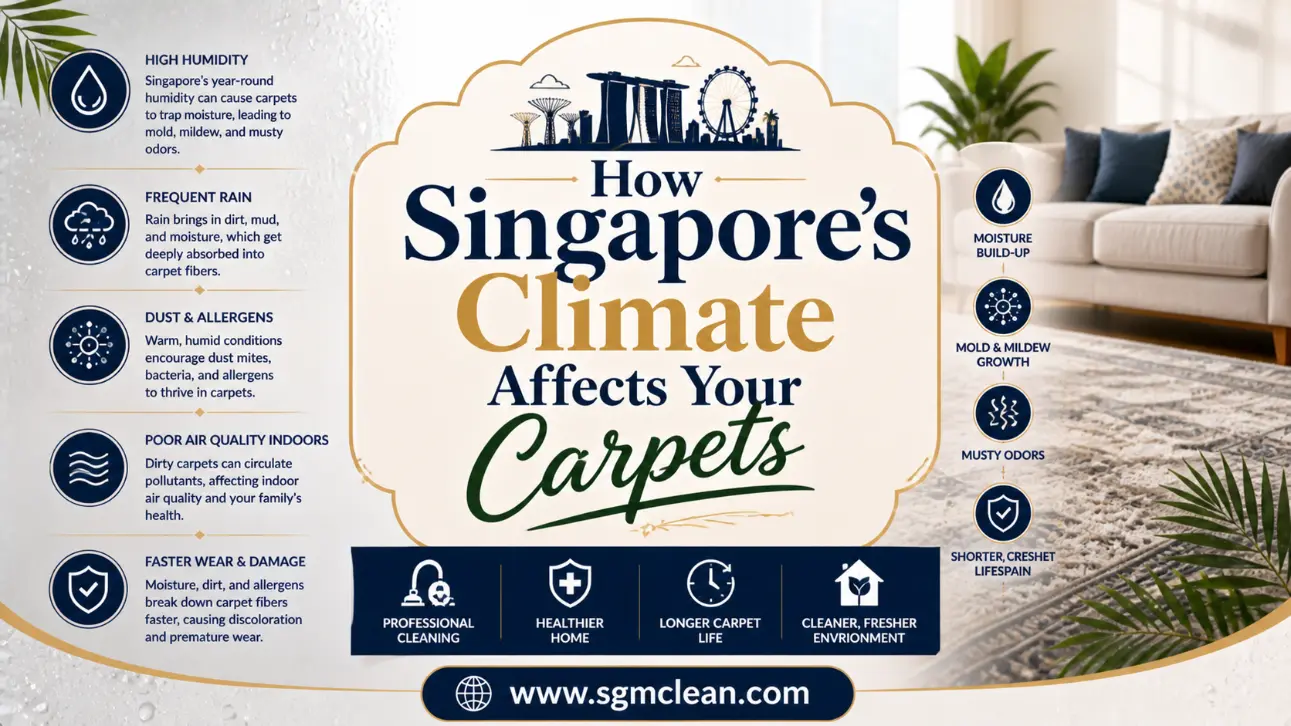
Singapore’s relative humidity typically ranges between 70% and 90% throughout the year, dropping slightly in air-conditioned spaces but rarely reaching the range considered optimal for indoor air quality and material longevity. For carpets, this persistent moisture in the air creates a continuous low-level wetting of fibres that has several significant consequences.
Carpet fibres — particularly natural ones like wool and cotton — absorb atmospheric moisture. Over time, this moisture penetrates through the pile and into the backing, creating damp conditions at the base of the carpet where air circulation is minimal. Combined with the organic material that inevitably accumulates in any carpet, these damp conditions are ideal for dust mite colonisation and mould growth.
Dust Mites: Singapore’s Most Persistent Carpet Problem
Dust mites are microscopic arachnids that feed on dead skin cells and thrive in warm, humid environments. They require a relative humidity above approximately 50% to survive — conditions that exist year-round in Singapore homes and offices. Carpets are one of their preferred habitats because they offer warmth, food, and protection from disturbance.
A carpet that has not been deep cleaned in some time can harbour extremely high dust mite populations. Their waste particles are the primary cause of dust mite allergy — which is extremely prevalent in Singapore — manifesting as sneezing, itchy eyes, runny nose, and asthma-like symptoms. Regular vacuuming reduces surface mite populations but does not address those embedded deep in the pile. Only professional deep cleaning with hot water extraction effectively reduces mite levels throughout the full depth of the carpet.
Mould: A Real Risk in Singapore Carpets
Mould growth in carpets is not as rare in Singapore as many homeowners assume. Any combination of sustained moisture — from high humidity, a slow leak, inadequate drying after cleaning, or a significant spill that was not fully extracted — and organic material in the carpet creates conditions where mould can establish.
Early-stage mould in a carpet is often invisible but detectable by smell — a persistent musty odour that does not clear even after the carpet has been vacuumed and the room ventilated. By the time visible mould growth appears on the carpet surface or backing, the problem is already advanced. Addressing mould early through professional treatment is far more effective than attempting to clean established growth.
If you notice a musty smell from your carpet, do not ignore it. Professional carpet cleaning in Singapore using hot water extraction removes the moisture and organic matter that feed mould growth and can address early contamination before it becomes a serious problem.
How Air Conditioning Affects Carpet Cleanliness
Air conditioning is essential in Singapore and does reduce indoor humidity in the immediate environment. However, it also creates specific carpet challenges. Air conditioning systems circulate air continuously, which helps distribute fine particulate matter — dust, pollen, pet dander, mould spores — throughout the room. These particles settle onto and into carpet fibres continuously during operation.
This cycling between drier and more humid conditions when air conditioning turns on and off is physically stressful for carpet fibres over time and creates the conditions for intermittent mould activity that can be difficult to trace.
Singapore’s Urban Environment and Carpet Soiling
Beyond humidity, Singapore’s urban environment contributes to carpet soiling in other ways. Fine dust from construction activity — a near-constant feature of Singapore’s landscape — settles on outdoor surfaces and is tracked indoors. The frequent rain creates wet footwear and tracked mud. The result is that carpets in Singapore homes and offices accumulate soil faster than those in cooler, cleaner-air environments, and a cleaning schedule appropriate for a carpet elsewhere may not be adequate here.
Practical Steps to Protect Your Carpet in Singapore’s Climate
- Vacuum frequently — at least twice a week in living areas, more often in high-traffic zones
- Use a dehumidifier in persistently damp rooms to keep carpet fibres drier
- Address spills immediately — moisture left in a carpet in Singapore’s climate creates mould conditions faster than in drier environments
- Maintain good indoor ventilation — open windows when outside air is drier, and ensure air conditioning is functioning efficiently
- Schedule professional deep cleaning every 3 to 6 months — more frequently than you might in a drier climate
- Remove shoes at the door — reduces tracked soil and outdoor moisture entering carpeted areas
Getting Professional Help That Understands Singapore’s Conditions
Professional carpet cleaners who work regularly in Singapore understand the specific challenges the climate creates and adjust their approach accordingly — including ensuring thorough moisture extraction to minimise drying time and the associated mould risk.
M Clean SG provides professional carpet cleaning services across Singapore for both residential and commercial properties. Their team is experienced in managing the specific cleaning demands that Singapore’s climate creates. Explore their services via their home cleaning page or contact them to arrange a carpet cleaning assessment for your property.
Singapore’s climate is not your carpet’s friend — but with the right maintenance habits and the right professional support, you can keep your carpets genuinely clean and healthy year-round.